Head and Expression
Functional Design of the Dachshund’s Head
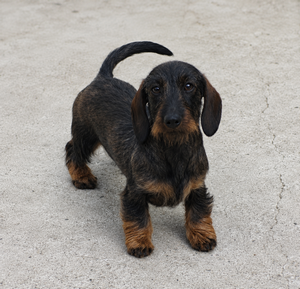
The head is one of the most characteristic features of the Dachshund. Its elongated shape, strong jaws, correct dentition, well-positioned eyes and ears combine to create the typical expression of the breed.
The FCI Breed Standard describes these characteristics in considerable detail, while the WUT Commentary helps explain how the individual elements of the head should be understood as parts of a harmonious and functional whole.
This page highlights some of the points that I found particularly useful in the official WUT Commentary. It is not intended to replace a careful reading of the complete FCI Breed Standard or the WUT publication.
The General Shape of the Head
The FCI Standard describes the head as elongated when viewed from above and from the side, but gradually tapering towards the nose without becoming pointed.
This distinction is important. The typical Dachshund head should give an impression of length and refinement, but it must retain sufficient strength throughout the muzzle and jaws.
The WUT Commentary draws attention to the relationship between the different parts of the head rather than considering muzzle length, skull shape or stop independently. The result should be a balanced head whose proportions remain unmistakably characteristic of the breed.
Skull and Muzzle Proportions
One of the particularly useful aspects of the WUT material is its attention to the proportions of the head.
The skull should be rather flat and merge gradually into the slightly arched nasal bridge. The occiput should not be strongly pronounced.
The muzzle should be long, sufficiently broad and strong. It should not appear weak, narrow or pointed when viewed either from above or from the side.
This is an important distinction when evaluating breed type: the desired length of the Dachshund head must not be achieved at the expense of substance.
The jaws and muzzle remain part of the functional construction of a hunting dog.
The Stop
The FCI Standard requires the stop to be only slightly indicated.
This contributes considerably to the characteristic profile of the Dachshund. A pronounced stop visually divides the skull and muzzle and changes the typical outline of the head.
The transition from skull to muzzle should therefore remain gradual, allowing the upper profile of the head to retain its characteristic elongated appearance.
The Nose and Nasal Bridge
The nose should be well developed, while the muzzle extends into a long nasal bridge.
The nasal bridge is described as slightly arched rather than completely straight or excessively curved.
This subtle characteristic contributes to the typical Dachshund profile and should be considered together with the relatively flat skull and slight stop.
Strong Jaws and Correct Dentition
The FCI Standard places considerable emphasis on the jaws and teeth.
The upper and lower jaws should be strong and well developed, and the required bite is a regular and complete scissor bite.
Correct dentition is therefore not merely a cosmetic detail. It belongs to the functional construction of the head.
The WUT Commentary also gives substantial attention to dentition and to the correct evaluation of missing teeth and bite faults. Because of its importance, this subject deserves a separate detailed chapter in this series.
Lips
The lips should be tight fitting and adequately cover the lower jaw.
This apparently small detail contributes to the clean outline of the muzzle. Loose or excessively developed lips would alter the characteristic appearance of the Dachshund head.
Again, the different features should not be considered independently: muzzle, jaws, lips and dentition together determine both the strength and the outline of the lower part of the head.
The Eyes
The expression of the Dachshund is strongly influenced by its eyes.
The FCI Standard describes them as medium-sized, almond-shaped, set well apart and with a clear, energetic yet friendly expression.
They should not have a piercing appearance.
The preferred colour is dark reddish-brown to blackish-brown, depending upon coat colour.
What I retain particularly from this description is that correct expression cannot be reduced simply to eye colour. Shape, size, placement and expression must be considered together.
An eye that is too round, too prominent or incorrectly positioned can substantially change the characteristic expression even when its colour is correct.
The Ears
The ears are another defining feature of the Dachshund head.
According to the FCI Standard, they should be set high but not too far forward, sufficiently long but not exaggerated, rounded rather than pointed, mobile, with the front edge lying close to the cheek.
Their position and carriage contribute considerably to the expression.
The WUT material is useful here because it encourages us to consider the ears in relation to the entire head. Ear length alone does not determine correctness; attachment, shape, carriage and harmony with the skull are equally important.
Expression Is the Result of the Whole Head
One point becomes particularly clear when the individual requirements of the standard are considered together: there is no single anatomical feature responsible for the typical Dachshund expression.
It results from the combination of:
- an elongated but strong head;
- a relatively flat skull;
- a slightly indicated stop;
- a long and substantial muzzle;
- a slightly arched nasal bridge;
- correctly shaped and positioned eyes;
- correctly set and carried ears;
- strong jaws and correct dentition.
Changing one of these relationships can change the overall expression considerably.
This is why the head should ultimately be evaluated as a complete anatomical unit rather than as a collection of isolated features.
Function Before Exaggeration
As in the previous chapters, the functional origin of the breed remains important.
The Dachshund was developed as a hunting dog, and its head must therefore combine breed type with functional strength. An extremely refined or narrow head may emphasize apparent length, but it should not replace the substance required in the muzzle and jaws.
Likewise, exaggerating individual characteristics — an excessively pronounced stop, very prominent eyes, an extremely narrow muzzle or exaggerated ears — does not strengthen breed type. It changes the balance described by the standard.
The characteristic Dachshund head is therefore the result of proportion, strength and harmony rather than exaggeration.
At TonyaWire Kennel
At TonyaWire Kennel, the head and expression are considered together with the complete construction of the dog.
In studying the FCI Breed Standard and the WUT Commentary, I retain particularly the importance of preserving the characteristic elongated head without losing strength and substance, together with correct jaws and dentition, properly shaped eyes and correctly positioned ears.
Within our breeding programme, these characteristics are considered alongside correct anatomy, balanced proportions, efficient movement, functional wire coat, stable temperament and genetic health. The objective is not to exaggerate individual features, but to preserve the harmonious and functional breed type described by the Dachshund Standard.